Tuesday, 10 August 2010

Judy Siers - Researching HB History and the Women's Rest


Judy Siers has been busy over the las few years involved in a lot of local history projects, one in particular was the "King George Coronation Hall" in Petane built in 1911 to celebrate the coronation of King George. Designed by world-renowned Art Deco architect, Louis Hay, the King George Hall has been an important part of the Bay View community since 1911. It has recently been renovated and painted and Napier City Coincil have commissioned her to write its history.

In her travels she noticed that Hastings have a coronation fountain and monument as a tribute to King Henry in Cornwall Park. Mayor Viggor Brown had a Coronation Hall built in Napier.


Judy Commented on how she is still finding information on James Walter Chapman Taylor.
She showed us 3 painting she had found Turama, Tauroa, and Frederick House he built for his parents all watercolours.


The Womens Rest

The history really started back in 1885 when members of the Women's Christian Temperance Union movement who were recruited to come out to Nz Australia and help women and families.

by the end of 1885 there were 15 branches established in New Zealand including one in Napier.
The WCTU was organized by women who were concerned about the the destructive power of alcohol and the problems it was causing their families and society.
They met in churches to pray and then marched to the saloons to ask the owners to close their establishments. These activities are often referred to as the "Women's Crusades" and their success was both the forerunner and impetus for the founding of the WCTU.
The most famous member and second president of the WCTU was Frances E. Willard who served from 1879 until her death in 1898.


One of the most famous WCTU members was Mrs Lovell-Smith the wife of Hastings photographer Herbert Lovell-Smith who was instrumental in getting the Hastings Branch of WCTU up and running in 1903. The white Ribbon "For God Home and Humanity" was worn by all members. By 1904 Napier Branch had large membership and funds they built the "Willard Institute Building for the WCTU named after teh founder in America.

Ruth Lovell-Smith moved to Hastings in 1918 was always pushing Council to build a "Womens Rest". Not taking no for an answer she set about opening a "Mothers Rest" in Heretaunga Street to prove to Council that Hastings need one. It was so popular and drew the attention o the media. Ruth then got Council on her side and things started to happen. The Garnett Family agreed to sell their timber yard to make way for roading and a "Women's Rest" Mrs garnett said she would give back 750 pound to Council when the Women's rest was built.


Sir George Ebbett who was the incoming mayor continued with the project clearing land and finally laid the first stone of the Women's Rest on the 23rd March 1921.


Plunket were also keen to see a Women's rest established and were also backing the movement

lead by Ruth Lovel-Smith. The Plunket have been part of the Women's right from when it opened.


The Hastings Municipal Women's Rest, built in 1921, is likely the first example of a women's rest built exclusively and separately for this purpose in New Zealand. Funded largely by private contributions and administered and constructed by the Hastings Borough Council this rest took over from an earlier rest room in the area that had been furnished and administered by the Hastings branch of the Women's Christian Temperance Union.The building is a very good example of the Californian bungalow style of architecture, a domestic building normally associated with residential dwellings. The building exhibits many of the distinguishing features of the style and remains in remarkably authentic condition after 85 years in the same use. The building also demonstrates what Cooper et al refer to as a shift from 'public lavatories' to the elaborate buildings of 'rest rooms' designed to accommodate mothers and workingwomen. Located in the central business district in the city's civic square, the Hastings Municipal Women's Rest provided a centrally located rest room space for women and access to other facilities, such as the Hastings branch of the Plunket Society. From the beginning, the rest room facilities were widely used by women from out of town, women who worked in Hastings, and mothers who were visiting Plunket. Since 2003, the building has also been used as a base for the Heretaunga Women's Centre. It continues to be used as a space for women today. As an early example of a women's rest room and most likely the first women's rest built exclusively and separately for this purpose the Hastings Municipal Women's Rest merits Category I registration. The history of the Hastings Municipal Women's Rest assists in showing not only the struggle of women to obtain these services in their community and the evolving provision of these services by volunteers and borough councils, but also touches on the work of organisations of high significance to women at this time such as the WCTU and Plunket. The integrity of the building and its aesthetically pleasing surroundings assist in the telling of this story. The Hastings Municipal Women's Rest is also socially significant within the Hastings region as it has been patronised both by local residents and visitors from the country for over 85 years.

Sunday, 1 August 2010

Judy Siers - Researching HB History and the Women's Rest

Judy Siers will talk on researching Hawke's Bay history, with special mention of the Hastings Women's Rest building.
Tuesday 10th August 2010
5.30pm
Hastings Central Library

Tuesday, 13 July 2010

Hawke’s Bay Helicopter Rescue Trust, Lowe Corporation Rescue Helicopter Service


Late 1960’s
In the early days, local helicopter operators were used when helicopter retrieval and transport was required for patients.
The local operator would come in from their agricultural work and reconfigure the helicopter into an air ambulance. They would remove the spraying gear and replace it with a stretcher, which was often mounted on to the helicopter skids!
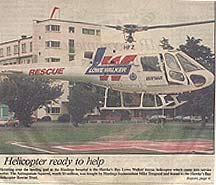
As you can see from the photo, once airborne, communication with the patient was almost impossible due to the noise of the helicopter and wind.
The helicopter would normally take the patient to a waiting ambulance before being transported to hospital by road.


1970’s
In the early 1970’s the part-time service attended between 20-30 rescues a year.
The helicopter would sometimes transport the patient directly to hospital or to the road where it would be met by an ambulance.

1980’s
In 1984, the Hawke’s Bay Helicopter Rescue Trust was established from an auction group set up by Chief Inspector Paul Wiseman.
The service was initially established for water rescues and in 1989 expanded to involve patient transfers, police searches, accident recovery and marine emergencies.
The auction group included the Porangahau Diving Club, Waimarama Surf Club, Police, Civil Defense, as well as existing members Noel Houston, Garrie Griffiths and Trauma Doctors Forbes Bennett and Greg Beecham.
Dr Forbes Bennett and Dr Ted Ward from the Hastings Hospital were key supporters of the retrieval and transportation system offered by the service. They were committed to the ‘miracle hour’ theory of getting severely injured people to a medical facility for treatment.
In 1985 a CAA approved helicopter pad was completed at the Hastings Hospital (now named the Hawke’s Bay Regional Hospital).
A Bell Jet Ranger helicopter, owned by Wanganui Aero Works, was used for the rescues and in 1989 the machine was sold to Mike Groome of Te Onepu Helicopters and continued doing part time rescue work.
1988 HB Helicopter Rescue SquadClick image to zoom in
With the arrival of better helicopters (Hughes 500 and Bell Jet Ranger) the air ambulance service greatly improved, especially for the patient as they could be carried internally.


1990’s
In 1991, the Trust came to a ‘cross roads’ when Te Onepu Helicopters sold the helicopter and the Trust had to decide whether to discontinue or to set up a dedicated service.
The Trust and the Hospital recognised the value of the service to the region and decided to pursue the option of setting up a dedicated service.
Andy Train, who was the Commissioner of the Hawkes Bay District Health Board, approached Hastings businessman Mike Toogood, to see if he would be interested in undertaking the necessary investment and work to establish a dedicated rescue service.
Within five months, the dedicated service became a reality when Mike Toogood purchased a Eurocopter AS350BA “Squirrel” helicopter and secured sponsorship support from Lowe Walker NZ Ltd.


As a condition of the Lowe Walker sponsorship, Mike Toogood became the CEO of the Trust and held responsibility for the operation of the rescue helicopter service, responsibilities that continue to the present time.
In 1992, the first helicopter hangar was built at the Hawke’s Bay Regional Hospital and in 2001 a larger facility was established in the hospital grounds when the hospital decided they needed the original site. The hangers were built with generous support from the Hawke’s Bay businesses and the community.
In 1997, Lowe Walker changed their company name to Lowe Corporation. The service has since been known as the Lowe Corporation Rescue Helicopter Service and Lowe Corporation continue to be the Trust’s Principal Sponsor.
2000’s
The Hawke's Bay Helicopter Rescue Trust continues to flourish and expand its capabilities, thanks to the generous support and contributions made by individuals, groups, businesses and sponsors within the Hawke’s Bay community.


Friends of the Hawke’s Bay Helicopter Rescue Trust, Lowe Corporation Rescue Helicopter Service support this service with their financial donations each year.

Thursday, 24 June 2010

Monday, 21 June 2010

Waikaremoana a History by Sir Rodney Gallen

Waikaremoana a history by Sir Rodney Gallen
Sir Rodney Gallen is a retired lawyer (now aged 71) who lives in Havelock North, near Hastings a former and now retired High Court Judge. Sir Rodney Gallen KNZM is also a talented local musician.
.

LAKE WAIKAREMOANA AND TE UREWERA NATIONAL PARK Like rough-cut emeralds, Lake Waikaremoana (Sea of Rippling waters) and its little sister, Lake Waikareiti, are set perfectly in the 225,000 hectares of Te Urewera national Park – the largest untouched native forest reserve in the North Island.
The primeaval rain-forest is home to many native birds and remains today as virgin as it was in the 1840's, when Pioneer Missionary William Colenso traversed this remote homeland of Tuhoe, “Children of the Mist”.
The lake itself is a very new feature on a geological time-scale. Previous to its appearance, a very deep narrow gorge cut through the land-block which forms the highlands of Ngamoko and Panekiri. Some 2200 years ago a tremendous landslide rumbled down, probably as a result of a severe earthquake or possibly as a result of continued erosion. The landslide came down from the Ngamoko Ridge carrying millions of tons of fractured rock into the canyon. Across the canyon a huge pile of debris about 300 metres high came to rest. The area is formed from young mudstone, siltstone and sandstone, mostly about 10-15 million years old. These sediments were originally part of the sea floor, but about two million years ago uplift brought them above sea level. The mountains and hills of the area have been shaped by continuous erosion. Major valleys like the Aniwaniwa Valley have been carved more deeply from softer mudstones, while the more solid sandstones have tended to form ridges like Panekire. This vast dam enabled the rainwater to collect into a lake which as it rose gradually backed up the various branches of the former stream to form the many arms and inlets of present day Waikaremoana. As it rose and submerged the forested slopes the trees were killed, although the sturdy trunks of many of them remain standing today. When the lake is low, hundreds of them appear near or above the surface. Toward the end of the 18th century narrow strips of land bordering the lake were designated as bird sanctuaries. Trout and deer were introduced and a ranger was stationed here in Opourau (Home Bay). The Lake House, previously sited above the camp, was a popular Tourist Hotel Corporation hotel and was the end of the road from Wairoa until the road through to Rotorua was completed in 1930. The largest of the 3 hydro-electric stations, Tuai, was completed in 1929. The water released from this was impounded, in the man made lake Whakamarino, and by 1943 this was being used as a supply for the lowest station Piripaua. As work was completed there, the upper development at Kaitawa commenced.


As much as possible of the leakage from Lake Waikaremoana had to be sealed off so that the flow of water could be regulated. Kaitawa commenced operation in 1948. The creation of Urewera National Park was announced on September 29th 1953.

Friday, 21 May 2010

Waikaremoana : Sir Rodney Gallen

Landmarks History Group guest speaker in June is Sir Rodney Gallen who will speak on the history of Lake Waikaremoana.
Hastings Central Library
Tuesday 8th June 2010
Upstairs, 5.30 - 6.30pm.

Tuesday, 18 May 2010

Hamilton Logan Richmonds Part 2

Chairman Sam Robinson and Waitotara founder Rod Pearce remain the only two farmer-directors in what was, until 1997, a wholly farmer-owned, unlisted, under-valued and history-bound Hawke's Bay regional meat company.The heavyweight board will want to extract maximum value out of a buoyant international meat trading situation, hoping that Loughlin and his team could shave the cents and make lucrative trading decisions while the sun shines.Future growth will not come from procurement share increases, which may have driven growth in recent years. It will come from continuous improvements in operational efficiency and marketplace performance.The future belongs to processors that can find new meat cuts and presentations to take them to new levels of profitability, for the customers, suppliers and shareholders. These must be branded and differentiated food products, he says, rather than commodity sales. The Brian Richards-inspired re-imaging of Richmond is essential in the quest for added value for Richmond. It has been about unifying the fragmented and often adversarial supply chain and changing the thinking in the company’s business-to-business relationships.Essentially, employees and suppliers have to see themselves putting attractive meal propositions in front of someone on the other side of the world.Recent historyRichmond pottered along profitably for that decade following one of the big industry rationalisations that were a feature of the 1980s. Richmond purchased Dawn Meat and Pacific Freezing and participated in the closure of Whakatu and the purchase of Takapau from Hawke’s Bay Farmers Meat Co, all during an eventful 1986. The closure of Whakatu was the best for all of Hawke’s Bay.To closure Wairoa would have killed Wairoa as it only has its hospital and Freezing works as two major employers. Hastings and Napier while devastating has much better job opportunities for the redundant employees. They still had one Freezing works and lots of other major industries.Faced with two pivotal decisions in the early 1990s, Richmond declined to get involved with the divestment of Waitaki to Affco and Alliance and a possible purchase of cash-strapped Weddel. Richmond was wise because it would have been buying the wrong set of assets and be headed for disaster. These decisions were before his time at Richmond, which began in 1993 as finance manager for the company, after earlier periods as an investment banker and chartered accountant.However, given the acquisitive nature of the times, those decisions could have condemned Richmond to a regional backwater of the rapidly coagulating meat industry or, worse still, a takeover target.Richmond’s big chance came in an offer to sell out of beef and lamb processing by Hawke’s Bay neighbour Graeme Lowe, of Lowe Walker, also strongly positioned in Northland and Taranaki, where Richmond did not operate.The $27-million purchase, completed in March 1998, quadrupled beef processing and focused new Richmond team on making a success of the large takeover, after opportunities for due diligence had been limited.A subsequent rationalisation of beef facilities closed Lowe Walker Hastings, converted Te Kauwhata to deer and then closed Otaki early in 1999.It took out 17 percent of our beef fixed costs while maintaining throughput at Dargaville, Te Aroha, Hawera and Hastings.Our investment adviser said he had never seen such a complementary fit of facilities, which gave Richmond the benefits of great synergies.A second round of lamb-processing facility rationalisation affected three plants in and around Napier/Hastings and one at Hawera while consolidating further processing in the $14-million new FoodTech plant on the Takapau site.Again, this took out 15 percent of lamb-processing costs for a small slaughter capacity reduction coupled with a large further-processing improvement.Next up was the Waitotara Farmers Meat Company merger (in October 1999) which swapped money and shares for the lamb plants at Waitotara (northwest of Wanganui) and Tirau, southern Waikato. It added a million lambs a year throughput, which is disappointing considering the size of Waitotara before the merger, but the focus of this move was to strengthen its geographical position and “bank the synergies”.In a paper called “Pursuing a Food Company Vision through M&A” presented to the Institute of Directors seminar in Wellington on November 3, 2000, Waitotara brought $2 million in EBIT and $8 million in synergies.Candidly, Richmond was exhausted by the time of the Waitotara assimilation and missed some opportunities and disaffected Waitotara farmer-suppliers decamped to other meat companies.Likewise Richmond has not made all it could have from the purchase in July 1998 and subsequent development of the Gourmet Direct upmarket local supply business, now the flagship for Richmond in food service.. Expansion-fatigue may also be indicated in his assessment of Richmond’s size presently as adequate for all that the company needs to do.Neither Loughlin nor, he believes, any members of the board set out deliberately to become the biggest meat company in New Zealand.“But there was a moment during long discussions about whether to acquire Lowe Walker, when one director said, ‘we had better consider where Richmond will be if we don’t buy Lowe Walker’.”The company has made three consecutive increases of more than $200 million a year in turnover, quickly taking it from number four in the industry by size to number one.A period of consolidation is dictated, taking out costs, raising efficiencies and developing new products.Richmond can never drop its risk management vigilance in such a low margin enterprise, he says.When earnings are as low as one to two percent of sales, a few wrong supply or sales contracting decisions can wipe out profit and a number of them can wipe out the company’s $120-million capital base. This has been a sadly recurring pattern in the meat industry.John Loughlin’s second year as Richmond CEO was the beginning of the distracting noises, as PPCS contended with Affco for control of one-third of Richmond being tendered by the Meat Board.When both were rebuffed, the shares went to the supposed Richmond-friendly investor grouping of HKM; three Maori business people.Not deterred, PPCS wooed HKM and in 1999 was again on the brink of control when Richmond’s farmer-shareholders successfully challenged the PPCS processes and repulsed the raider.A company called Active Equities, owned by Paul Collins and Bruce Hancox, rode to the rescue of Richmond, but that horse has also turned Trojan.Third time-lucky in 2000, PPCS purchased 16.7 percent of Richmond shares (10 percent from Auckland farmer-businessman Peter Spencer) and paid $3.65 a share for 49 percent of Hawke’s Bay Meat Holdings, a joint venture with Active Equities to own 35.8 percent of Richmond’s 41 million shares. Should it exercise the right to purchase the remaining 51 percent of HBMH between February and September 2003, PPCS will then own 52.5 percent of Richmond.The drawn-out fight for ownership control was more distracting for company employees who are fixed in the industry and the Hawke’s Bay region.If company executives had got involved in the industry politics then it would have derailed what we were trying to achieve. Perversely, yet another measure of the Richmond success to date has been the persistence of PPCS in gaining control, although the outcome for Richmond is as yet uncertain. PPCS presumably had an opportunity to block Loughlin’s nomination to the board of directors (before the annual general meeting in December) but chose to endorse his promotion in the expectation of further earnings growth. With two good years behind it and one good year in prospect, Richmond directors finally decided to seek a main board listing on the Stock Exchange last February, along with a $50-million capital notes issue.“Since the 1980s there had been a lot of debate as to whether listing was consistent with long-term farmer ownership..“Without farmers and without their stock coming through, any meat company only has a lot of assets in obscure places with redundancy obligations attached.“So we have to ensure returns are sufficient to sustain both the farming community and to reinvest in the business.“For a long time no-one was winning, with farmers and companies scrapping over the crumbs of the cake,” The listing eliminated the secondary market discount (of 25 to 30 percent) by making the market for shares more liquid. Many among 1900 smaller (mostly farmer) shareholders have benefited, and PPCS fronted up with cash to Spencer, Collins and Hancox pushing the share price to $3 briefly before settling down around $2.60.The money raised from the sale of capital notes has retired bank debt and provided funds for further re-quipping, just completed at Oringi, Te Kauwhata and Pacific Beef (Hastings).While they are an expensive substitute for bank funding, capital notes strengthen the balance sheet and may help to secure the company against prolonged downturns.As a substitute for equity, where Richmond trades on a price/earnings multiple of 5:1, [an after-tax cost of equity of 20 percent], then capital notes, with a pre-tax cost of funds at 10.75 percent, plus tax deduction, sit somewhere between debt and equity in terms of cost, strength and so forth.